Best Online Dental Assistant Programs for Flexible Career Training
If you’re considering a career in dental assisting but need flexibility, online programmes are a great option. They let you study at your own pace, balance other commitments, and prepare for a growing job market. With around 381,900 dental assistant roles available and a projected 6% growth by 2034, it’s a promising field. Salaries average £37,000 annually, making it an attractive choice.
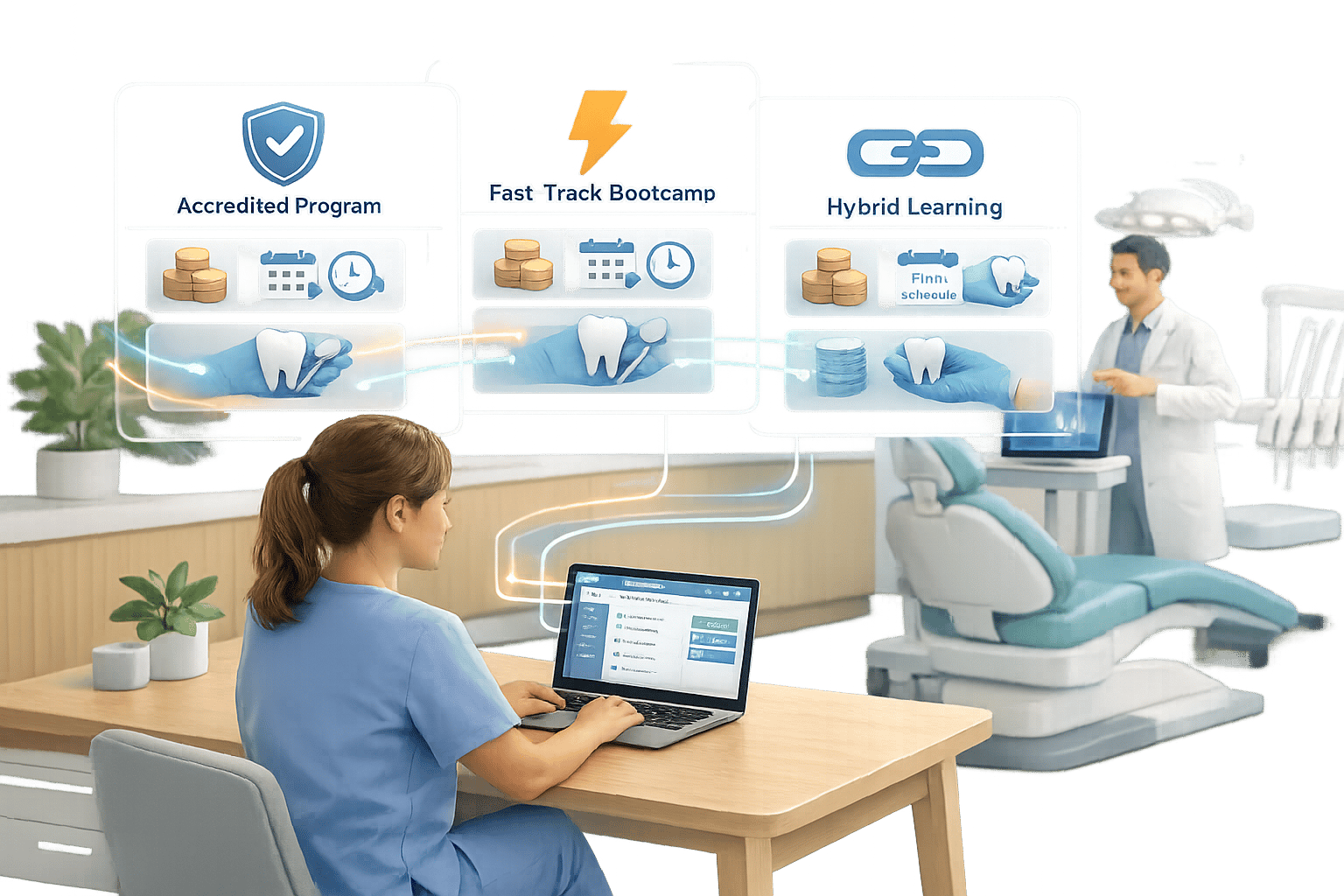
Here are three training options to consider:
- Accredited Online Programmes: Fully digital, covering topics like radiology and dental anatomy. Example: U.S. Career Institute (£1,239 upfront).
- Private Bootcamps: Fast-track, self-paced courses with virtual labs. Example: U.S. Career Institute (£1,239 upfront or £79/month).
- Hybrid Programmes: Combine online theory with in-person externships. Ideal for hands-on experience.
Each option has pros and cons depending on your goals, schedule, and budget. The key is to pick a programme that aligns with local regulations and prepares you for certification.
1. Accredited College-Based Online Programmes
Accredited college-based online programmes provide a comprehensive and structured way to train as a dental assistant, offering a fully digital curriculum. These courses cover essential topics like radiology, chairside assisting, dental anatomy, and front office procedures - all without requiring in-person attendance. Even practical skills are taught through virtual labs, making the experience entirely online.
Typically, these programmes take between 5 and 10 months to complete. They use virtual labs and detailed, step-by-step instructions to help students develop hands-on skills remotely. However, licensing requirements can differ depending on where you live, so it’s a good idea to check with your local regulatory body to see if additional hands-on training is required before you enrol [1].
One standout option is the U.S. Career Institute, accredited by the Distance Education Accrediting Commission. Their programme prepares students to take the Registered Dental Assistant (RDA) exam, which is also available online [1]. Impressively, their graduates have a 79% pass rate on the RDA exam, compared to the national average of 62% [1].
“You will receive complete step-by-step illustrated lessons and virtual labs that prepare you for this rewarding, in-demand dental assistant career.” - U.S. Career Institute [1]
The programme costs £1,239 if paid upfront or £1,539 through monthly instalments. An exam fee of approximately £150 is included in the cost or reimbursed after completion [1]. These programmes offer a clear and structured path to earning dental assisting qualifications. Up next, we’ll explore private bootcamps, which provide a faster, more condensed training option.
2. Private Short-Course Bootcamps
Private bootcamps provide a fast-track option for those looking to become dental assistants. Unlike traditional semester-based programmes, these courses are designed for self-paced learning. Many students can complete the training in as little as 5 months, making it a quicker alternative. Despite the shorter timeline, these programmes still incorporate hands-on practice through virtual labs.
Rather than traditional in-person clinical rotations, students engage in detailed virtual labs and lessons. However, they are responsible for obtaining their own CPR certification, which is often required for national exams [1].
The U.S. Career Institute offers a programme tailored for the RDA exam, administered by American Medical Technologists (AMT). Under the guidance of Course Expert Melia Lewis, MEd, BSDH, the curriculum includes 31 interactive lessons. For those paying the full tuition upfront, the £150 exam fee is included [1].
“Our self-paced, online Dental Assistant program is designed to prepare you for certification (RDA) and a role as a Dental Assistant in as little as 5 months.” - U.S. Career Institute [1]
The tuition cost is £1,239 when paid upfront, or £79 per month, totalling £1,539. This fee covers essential study materials and career support. The programme is accredited by the Distance Education Accrediting Commission (DEAC), ensuring its credibility with employers. With a 4.8/5 rating on Trustpilot from 3,929 reviews, it has garnered positive feedback [1]. Up next, we’ll delve into programmes that blend online learning with critical in-person externships.
3. Hybrid Online and Externship Programmes
Hybrid programmes offer a mix of online learning for theoretical knowledge and in-person clinical placements for practical skills. Students can study the theoretical components remotely and then gain hands-on experience in a real dental practice. This setup is ideal for those who need flexibility in their schedules but still want to build practical expertise before starting their careers. In the UK, this approach aligns well with the established structure of dental nursing training.
Currently, the UK offers 32 courses dedicated to dental nursing within its training framework [2]. Many of these are available through distance learning, ensuring accessibility across the country [2]. Some programmes are vocational in nature, such as the Diploma in Dental Assisting and Dental Hygiene, which combines remote study with supervised clinical hours [2].
Accreditation matters. Programmes that are part of recognised vocational or college course frameworks - such as BTEC qualifications or apprenticeship routes - are more respected by employers compared to unaccredited short courses [2]. Choosing a programme listed under a regulated qualification framework can also improve long-term career prospects in dental assisting. It’s worth confirming a programme’s accreditation status before enrolling.
Funding is another key factor to consider. UK-based students can explore options like university bursaries, subject-specific scholarships, or funding through apprenticeships [3]. International students have additional opportunities, such as Chevening Scholarships or Commonwealth Scholarships, which even support distance learning in the UK [3]. The British Council’s Study UK guidance highlights:
“There are many funding options available for international students who want to study in the UK. They range from part-funding… to full-funding which covers programme fees, living expenses, and return flights to the UK.” - Study UK, British Council [3]
For those exploring funding opportunities, the Universities and Colleges Admissions Service (UCAS) and the UK Council for International Student Affairs (UKCISA) are excellent resources for finding grants and bursaries tailored to healthcare and dental training programmes [3].
Pros and Cons
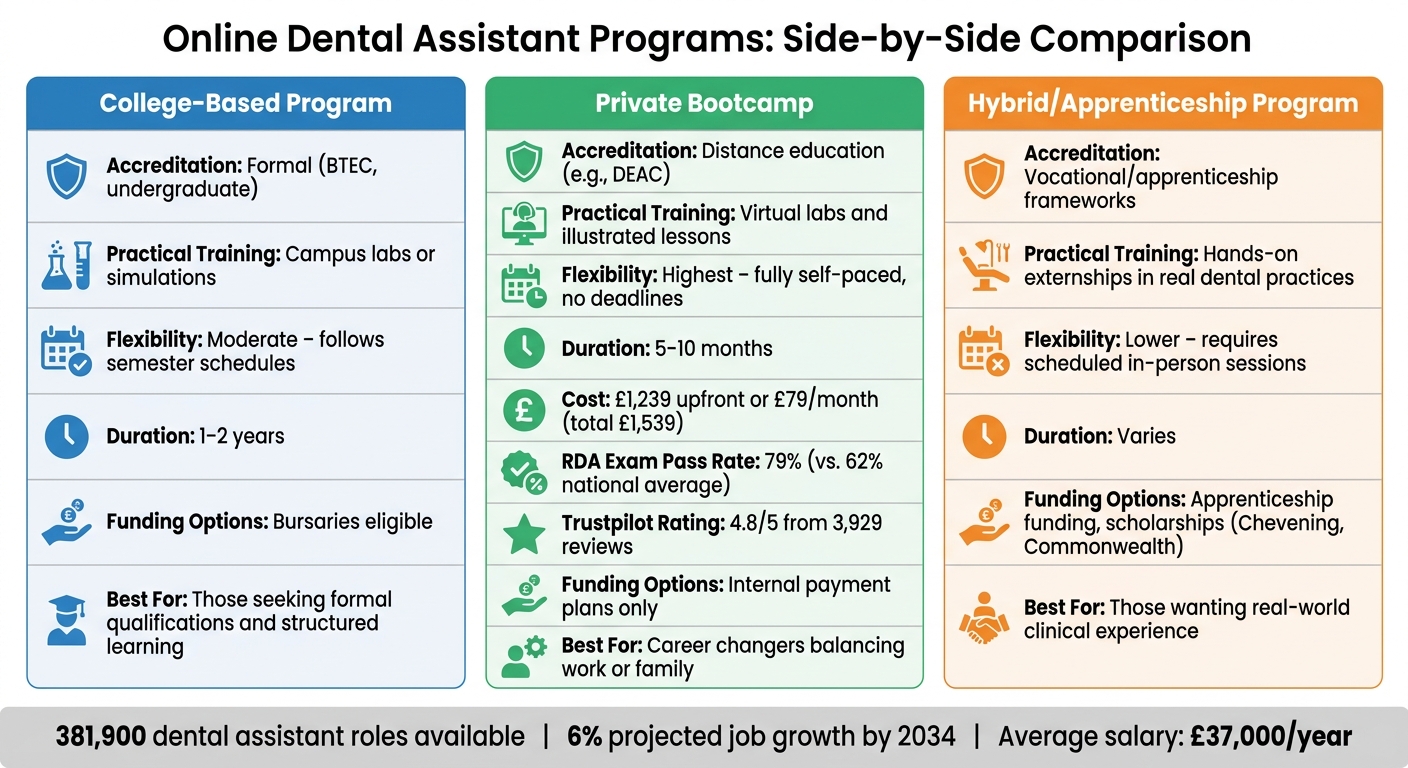
@figure {Online Dental Assistant Programs Compared: Cost, Flexibility & Accreditation} :::
Choosing the right dental career training programme depends on factors like your time availability, accreditation needs, and financial situation. Here’s a comparison of the main options:
Programme Type | Accreditation | Practical Training | Flexibility | Funding Options |
|---|---|---|---|---|
College-Based | Formal (BTEC, undergraduate) [2] | Campus labs or simulations | Moderate; follows semester schedules | Bursaries eligible [2] |
Private Bootcamp | Distance education (e.g., DEAC) [1] | Virtual labs, illustrated lessons | Highest; self-paced, no deadlines [1] | Internal payment plans only [1] |
Hybrid/Apprenticeship | Vocational/apprenticeship frameworks [2] | Hands-on externships in real practices | Lower; requires scheduled in-person sessions | Apprenticeship funding, scholarships [2] |
Let’s break down these options further:
College-based programmes typically take one to two years to complete and come with higher costs. They are ideal for those seeking formal qualifications and a structured learning environment. This option is particularly relevant for those aiming to meet compliance standards and deliver high-quality patient care in a clinical setting.
Private bootcamps are the fastest route, often completed in five to ten months. They are a great fit for career changers juggling work or family commitments [1]. However, they don’t qualify for government financial aid, so you’ll need to cover costs upfront or through instalment plans.
Hybrid programmes offer valuable hands-on experience through in-person externships. This setup is perfect for gaining practical skills before stepping into a dental practice [2]. While the required in-person sessions reduce flexibility, they provide a solid foundation for clinical work.
Each option has its strengths and trade-offs, so understanding your priorities will help guide your decision.
Conclusion
Choosing the right programme depends on your career stage and what you hope to achieve through training. If you’re switching careers, self-paced online certificate programmes are a popular choice. They allow you to continue working while studying and often don’t require prior experience. For beginners, programmes that gradually build knowledge and include virtual labs for practising clinical skills can be particularly effective.
If budget is a concern, consider free platforms that cover foundational dental assisting topics and align with GDC standards. For those willing to invest, structured bootcamps with flexible payment options - like Health Tech Academy’s zero-interest monthly instalments - strike a balance between affordability and efficiency. These programmes often combine exam preparation with practical skills training, giving you the tools needed for both certification and workplace success.
The curriculum itself plays a major role in outcomes. Programmes offering certification exam prep, career coaching, and hands-on skill development tend to deliver better results. This underscores the importance of selecting a course with a comprehensive and well-thought-out structure.
Before enrolling, ensure your chosen programme meets GDC standards for practising in the UK. Keep in mind that certification names and accreditation requirements differ across countries, so a qualification recognised in the United States may not automatically qualify you to work in a UK dental practice.
FAQs
Can I work in the UK with an online dental assistant qualification?
Yes, you can work in the UK with an online dental assistant qualification, provided it aligns with UK standards and practice requirements. Certain courses, like diplomas in dental assisting, often include skills applicable to UK practices. However, some roles may require formal registration or certification recognised by UK regulatory bodies. It’s essential to verify the exact requirements for the specific position you’re aiming for. :::
Do online programmes include real clinical experience?
Most online dental assistant programmes include opportunities for practical experience, such as externships, in-person placements, or simulated training. These experiences are crucial for building the hands-on skills needed to handle real-life situations effectively. :::
How can I verify if a programme is accredited?
To confirm if a programme is accredited, look for recognition by UK regulatory bodies such as the General Dental Council (GDC) or well-known educational institutions. Check whether the programme clearly states that it complies with UK standards or is acknowledged by the appropriate dental authorities. If you’re uncertain, reach out to the provider directly and request evidence of accreditation or recognition. :::