Multi-Branch Dental Analytics: What to Track
Running a multi-branch dental clinic can be challenging without a centralised analytics system. Many clinic owners rely on intuition instead of real-time data, leading to missed opportunities and hidden inefficiencies. To stay profitable, you need to monitor key metrics across all locations. Here’s what to focus on:
- Revenue per Patient: Measure how much each active patient contributes. Variations across branches can signal treatment planning issues.
- Patient Retention Rate: Aim for 85% or higher. Retaining patients is far more cost-effective than acquiring new ones.
- Chair-Time Utilisation: Track how effectively appointment slots are filled. Even small inefficiencies can lead to significant revenue losses.
- No-Show Rate: High no-shows waste time and revenue. Use automated reminders to reduce this.
- Branch Profitability: Analyse revenue against expenses like rent, salaries, and supplies to identify cost-saving opportunities.
Using cloud-based tools like Remedico’s Owner’s Dashboard simplifies tracking by providing real-time insights. Custom benchmarks for each branch and dentist-level data also help identify specific areas for improvement. By focusing on these metrics, you can make better decisions, reduce costs, and improve patient care across all locations.
How to Track, Analyze, and Manage Your Growing Practice with Dental Intelligence
Key Metrics to Track Across Multiple Dental Branches
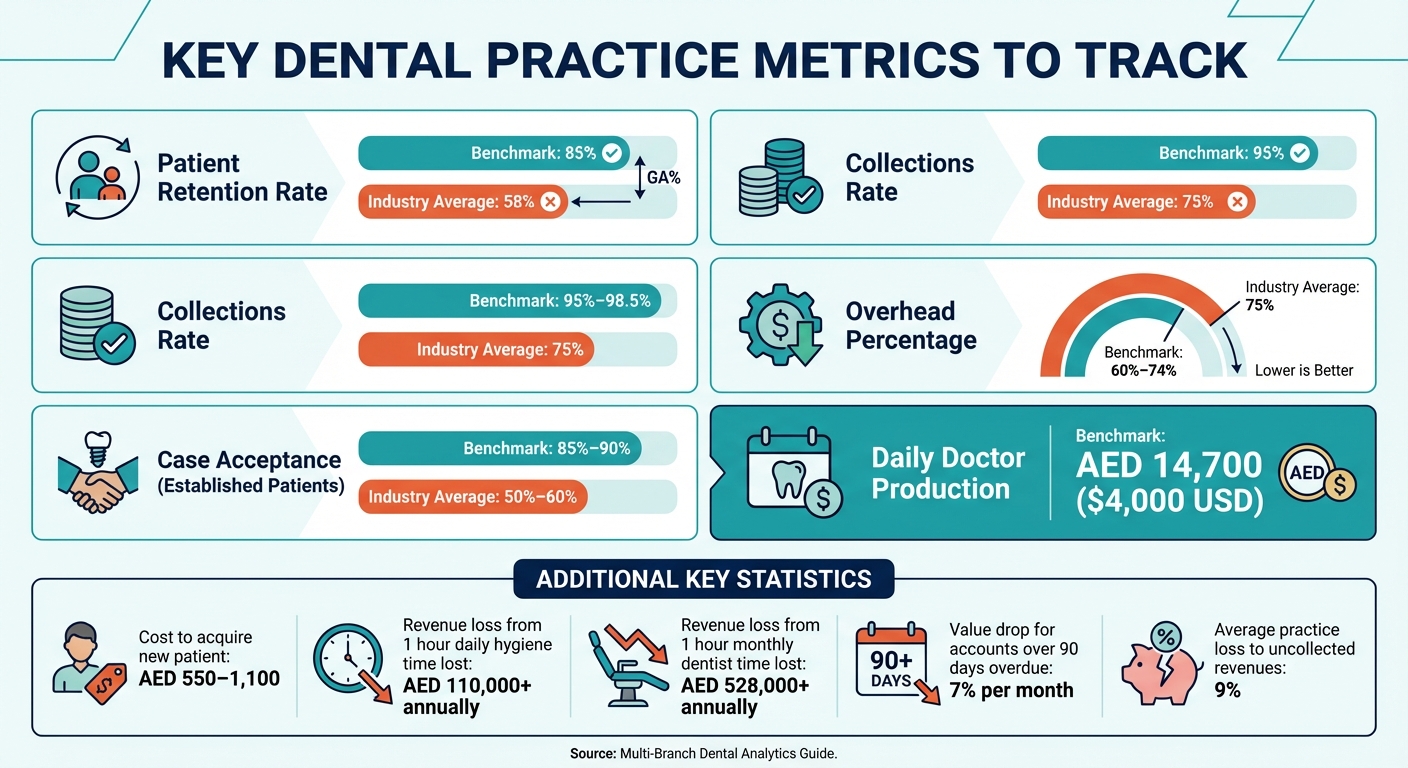
@figure {Key Dental Practice Metrics: Benchmarks vs Industry Averages} :::
Keeping an eye on the right metrics across your dental branches can reveal what’s working and what needs attention. From understanding revenue trends to improving patient loyalty, these key performance indicators provide a clear snapshot of branch success.
Revenue per Patient
Also called Annual Patient Value (APV), this metric shows how much revenue each active patient brings in. An active patient is anyone who has visited within the last 18 months. Interestingly, new patients often contribute more to APV due to initial “catch-up” treatments. To calculate, divide your total revenue by the number of active patients. If the numbers vary across branches, it may point to issues with treatment planning or case acceptance.
“Being busy as a bee doesn’t always equate to a topped-off bank account… a higher average production per patient will.” - Angela Ledford, Director of Marketing, Adit [3]
Tracking this monthly can uncover trends. With tools like Remedico’s Owner’s Dashboard, you can monitor this metric in real time, skipping the hassle of manual reporting.
Next, let’s look at patient loyalty through retention rates.
Patient Retention Rate
Patient retention measures how many active patients return for follow-up care. While the industry average sits at 58%, aiming for a retention rate of 85% or higher is ideal [1]. You can calculate this by dividing the number of returning patients within 18 months by your total active patient base. Differences in retention rates between branches can highlight operational or service-level challenges.
Retention isn’t just about keeping patients - it’s also cost-effective. Acquiring a new patient can cost between AED 550 and AED 1,100 [2]. Plus, loyal patients often refer others. Tools like Remedico’s Retention AI™ help by tracking patients who haven’t scheduled their next visit and sending reminders via WhatsApp or SMS, ensuring they stay engaged.
Now, let’s examine how efficiently your resources are being used with chair-time utilisation.
Chair-Time Utilisation
This metric measures how well your appointment slots are being filled. For instance, if chairs are available for 160 hours per month but are used for only 120 hours, your utilisation rate is 75% [7]. Even small inefficiencies can add up - losing just one hour of hygiene time daily could cost over AED 110,000 annually, while an hour of dentist time lost monthly could mean more than AED 528,000 in revenue [6]. Low utilisation often points to scheduling issues or last-minute cancellations.
Using tools like Remedico’s Smart Calendar, you can automatically fill gaps by suggesting available slots when cancellations happen, keeping chairs productive.
No-Show Rate
No-shows track the percentage of patients who miss appointments without cancelling. High no-show rates waste time, stress staff, and leave revenue gaps. Comparing rates across branches can help identify where patient communication might need adjustments. Multi-channel reminders - texts, emails, and calls - are effective in reducing no-shows. Remedico’s plans include 1,000 free WhatsApp reminders, which are sent automatically 48 hours before appointments, keeping patients informed and reducing your team’s workload.
Branch Profitability
Profitability considers total revenue minus expenses like rent, salaries, supplies, and lab fees. On average, dental practices face overhead costs of around 74% [3]. Even if two branches bring in similar revenue, differences in costs - like overspending on supplies or inefficient staffing - can make one branch less profitable. Breaking down costs helps identify areas for improvement.
Metric | Benchmark | Industry Average |
|---|---|---|
Patient Retention Rate | 85% [1] | 58% [1] |
Collections Rate | 95%–98.5% [1][3] | 75% [1] |
Case Acceptance (Established) | 85%–90% [2] | 50%–60% [2] |
Overhead Percentage | 60%–74% [3][2] | 75% [2] |
Collections are another critical area to monitor. Once an account exceeds 90 days overdue, its value may drop by 7% each month [6]. With Remedico’s integrated billing system, you can flag accounts nearing this threshold and generate detailed financial reports by location, dentist, or treatment type, helping you make better resource decisions.
How to Set Up Multi-Branch Analytics
You don’t need to overhaul your system to set up multi-branch analytics. The key is to connect all your branches to a central platform that collects data and generates easy-to-understand reports.
Use Centralised Software
Cloud-based management software is your best friend here. It pulls live data from all your locations into one place. For instance, the Remedico Owner’s Dashboard lets you track revenue, patient retention, and chair utilisation across all branches.
When choosing software, look for one that integrates seamlessly with your billing, scheduling, and communication tools. Deborah E. Bush highlights this by saying, “Dental practice management systems that automate the tracking and reporting of key metrics guarantee that the data is captured and usable” [5]. This is crucial, especially since 82% of dentists still face challenges due to outdated methods that don’t provide real-time data insights [1].
Create a Reporting Schedule
Consistency is key when it comes to reviewing data. Establish a weekly or monthly schedule to evaluate branch performance. Daily morning meetings can also help you stay on top of production goals, scheduling gaps, and unconfirmed appointments.
For example, regular reviews might reveal that one branch has a higher no-show rate or lower collections. These patterns could point to issues like staffing shortages or communication breakdowns. The good news? Remedico’s automated reports can be set to arrive in your inbox weekly, making it easier to act on these insights.
By sticking to a routine, you can translate data into actionable steps that improve patient management.
Connect Analytics to Patient Flow
Once you’ve centralised your software and established a reporting routine, it’s time to use those insights to refine your patient journey. This means tracking patients from their first consultation to follow-up visits to identify where drop-offs happen. Tools like Remedico’s Patient Flow™ map every stage - from the initial appointment and treatment plan to case acceptance and recare scheduling.
Here’s an example: If one branch excels in case acceptance but struggles with recare rates, the issue might be a lack of timely follow-up reminders. Automated tools like Retention AI™ can step in, sending WhatsApp or SMS reminders to patients who haven’t booked their next visit. This keeps patients engaged without overburdening your front desk staff. Considering that acquiring a new patient can cost up to AED 1,100 [2], focusing on retention is not just easier - it’s far more cost-effective.
3 Common Mistakes in Multi-Branch Tracking
Many multi-branch dental clinics face challenges when setting up their analytics systems, often creating blind spots that mask problems until they become costly. Below are three tracking mistakes that can block vital insights and hurt profitability. Addressing these issues highlights the importance of integrated tools like Remedico’s dashboards.
Relying on Manual Data Entry
Manual data tracking eats up valuable time that could be spent on patient care. Across multiple branches, it also increases the likelihood of errors, making it harder to get an accurate picture of performance. Did you know that the average dental practice loses about 9% of its production to uncollected revenues[4]? Add human error and bias in spreadsheets to the mix, and the problem only grows.
“If you are operating your business without the benefit of KPIs, you are not performing at the top of your game!”
Automated dashboards, like those offered by Remedico, eliminate these risks by pulling live data across branches. This way, you can catch issues early - before they spiral into expensive problems.
Next, let’s talk about why using the same benchmarks for all branches can lead to misleading conclusions.
Using the Same Benchmarks for All Branches
Not all branches operate under the same conditions. For instance, a clinic in Dubai Marina will face different patient demographics, insurance trends, and rental costs compared to one in Sharjah. Applying identical performance targets across these locations doesn’t account for these differences.
“Each location may have different needs based on patient volume, services offered, and local market dynamics.”
While the general overhead percentage for dental practices falls between 55% and 65%[8], this range can vary based on factors like branch size, specialty, and local market conditions. To stay accurate, conduct annual fee analyses and track metrics like the fee-for-service versus insurance production ratio for each branch[10].
Finally, let’s explore why ignoring dentist-level data can hide critical operational gaps.
Skipping Dentist-Level Analytics
Focusing only on branch-level data often means missing out on valuable insights about individual performance. Dentist-level analytics can uncover variations in procedure times or case acceptance rates that may be dragging down overall efficiency.
“Tracking who worked, the days they worked, and the procedures they performed can give you insight into revealing key performance gaps.”
For reference, the industry benchmark for daily doctor production is AED 14,700 (around $4,000)[1]. With Remedico’s provider-level reports, you can break down production by hour, appointment, or day. These insights pave the way for informed conversations that drive meaningful improvements across your branches.
Key Takeaways
Keep a close eye on essential branch metrics to identify problems early and make better decisions. Focus on areas like revenue per patient, retention rate, chair-time utilisation, no-show rate, and overall branch profitability. Instead of using the same targets for every location, customise benchmarks to fit each branch’s unique circumstances.
Use centralised systems like Remedico for real-time location insights. Automated dashboards allow you to track trends as they develop, eliminating the need to wait weeks for updates. Remedico’s integrated tools also help reduce manual errors and save time.
Tailor targets to individual branches, as locations like Dubai Marina and Sharjah operate under different conditions. Dive into dentist-level analytics too - individual reports can highlight staff members who might need extra support or training.
Automated tools can lower costs. For example, losing just one hour of dentist time per month could cost over AED 529,000 annually[6]. These systems not only save money but also improve care delivery and efficiency.
When combined with automation, these insights can lead to actionable improvements. Incorporate these strategies into your daily operations to achieve noticeable results.
Start small and grow strategically. Begin with daily team huddles, automate appointment reminders, and aim for a 98% collection rate[4][10]. With the right tools and consistent habits, you can transform data into meaningful action - and that action into sustainable growth.
FAQs
What are the best ways to improve patient retention in a dental clinic?
Improving patient retention in your dental clinic involves combining smart strategies with efficient tools. One effective step is to automate appointment reminders via SMS or WhatsApp. This helps reduce missed appointments and keeps patients actively engaged with their treatment plans. Additionally, monitoring key metrics such as patient satisfaction, treatment acceptance rates, and follow-up compliance can reveal areas that need attention.
Investing in a comprehensive practice management system can also transform your clinic’s operations. These tools streamline scheduling, billing, and patient record management, creating a smoother experience for both your team and your patients. Regularly analysing retention-focused KPIs enables you to identify patterns and adapt your strategies to better address patient needs. By implementing these approaches, dental clinics can strengthen patient relationships and encourage long-term loyalty. :::
How can cloud-based tools improve dental analytics for multi-branch clinics?
Cloud-based tools simplify the way multi-branch dental clinics keep track of and analyse performance across different locations. These tools provide real-time access to critical metrics, allowing clinic owners to stay on top of trends like patient retention, revenue streams, and appointment efficiency - no matter where they are.
By storing data in a centralised system, operations become easier to manage and far more organised, cutting down on administrative hassles. Plus, these tools encourage better collaboration between branches, ensuring teams deliver consistent patient care and make smarter, data-backed decisions to boost overall clinic performance. :::
How does better chair-time utilisation improve my clinic’s profitability?
Efficient use of chair time is a major factor in improving your clinic’s profitability. By cutting down on idle moments and maximising the number of patients you see each day, you can boost revenue without putting unnecessary strain on your team or resources.
On top of that, smart scheduling helps maintain a steady patient flow and keeps waiting times to a minimum. This not only enhances patient satisfaction but also encourages loyalty, building trust and paving the way for sustained financial growth for your clinic. :::