
How to Raise Dental Fees in the UK Without Losing Patients
- Analyse Costs: Review your expenses, including fixed (rent, salaries) and variable costs (gloves, lab fees). Don’t forget hidden costs like no-shows and software subscriptions.
- Benchmark Pricing: Compare your fees with local practices and NHS charges. For example, as of April 2026, NHS Band 1 treatments cost £27.90.
- Segment Patients: Understand which patients or services generate the most revenue. Tailor communication to different groups, addressing NHS and private patient concerns separately.
- Communicate Clearly: Provide 6–8 weeks’ notice before changes. Explain why fees are increasing, focusing on improvements like better materials or equipment.
- Offer Payment Options: Introduce instalment plans or membership schemes to make treatments more affordable.
- Handle Objections: Listen to concerns, explain the value behind the fee changes, and suggest solutions like phased treatments or financial assistance options.
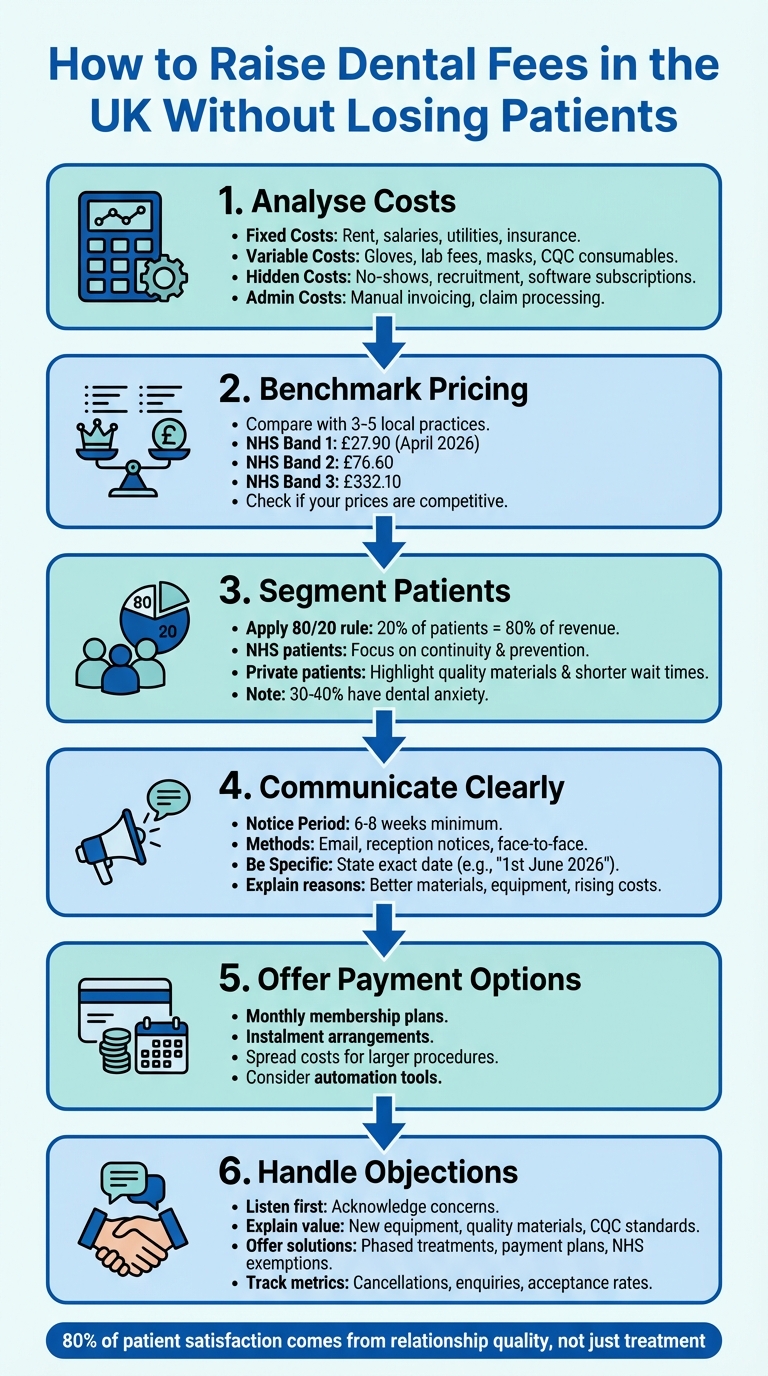
@figure {6-Step Guide to Raising Dental Fees Without Losing Patients} :::
Planning Your Fee Increase
Before announcing any fee changes, it’s crucial to pin down the reasons for the increase and decide on the exact adjustment. Start by analysing your practice’s actual costs over the past year. Pay close attention to variable expenses like lab fees, gloves, masks, and CQC consumables, which tend to rise alongside treatment volumes.
Don’t forget to account for less obvious costs - things like no-shows, recruitment, and software subscriptions. These can quietly eat into your profits. Additionally, manual invoicing and claims processing can drain clinical time, so consider automation to reduce these inefficiencies.
Review Your Costs and Profitability
After identifying your expenses, compare your fees with those of nearby practices. Call three to five local clinics and ask about their charges for common treatments like exams, fillings, and crowns. If your prices are noticeably lower, you might have room to increase them without losing your competitive edge.
Use NHS patient charges as a benchmark for entry-level services. As of 1 April 2026, NHS Band 1 (diagnosis, advice, planning) is priced at £27.90, Band 2 (fillings, extractions, root canals) at £76.60, and Band 3 (crowns, bridges, dentures) at £332.10 [3]. These figures can serve as a reference for budget-conscious patients comparing private and NHS options.
Cost Category | Examples to Review | Impact on Fee Calculation |
|---|---|---|
Fixed Costs | Rent, utilities, salaries, insurance | Must be covered regardless of patient volume |
Variable Costs | Lab fees, gloves, masks, CQC consumables | Scale with treatment; fees must adjust accordingly |
Hidden Costs | No-shows, recruitment, software subscriptions | Requires a buffer in profit margins |
Admin Costs | Manual invoicing, claim processing | Reduces clinical time; automation can lower these overheads |
Once you have a clear understanding of your cost structure, the next step is to assess how your pricing aligns with your patient base.
Understand Your Patient Mix
Not all patients will respond to fee changes in the same way. Apply the 80/20 rule: identify the 20% of patients or services that generate 80% of your revenue [1]. Focus on these key areas to ensure that any adjustments don’t alienate your most valuable patients.
Take a close look at your appointment types as well. If you handle a higher volume of urgent appointments compared to routine ones, keep in mind that from April 2026, high street dentists will need to offer a minimum number of urgent or unscheduled appointments [2]. This could mean more NHS patients qualifying for priority slots, potentially reducing your capacity for private patients.
Tailor your messaging based on patient type. For NHS patients, emphasise continuity of care and preventative measures. For private patients, highlight benefits like high-quality materials and shorter wait times [1][2]. Also, remember that 30–40% of people experience some level of dental anxiety [1], so address concerns about cost and trust in your communication.
These insights will help you craft a message that resonates with each patient group.
Write Your Communication Plan
Using your cost review and patient segmentation, create a clear and thoughtful message about the fee increase. Align your communication with broader healthcare trends, such as the NHS “10 Year Health Plan”, which focuses on prevention rather than just treatment [2]. This positions your practice as prioritising long-term oral health over short-term profit.
Many patients are already aware of rising costs in healthcare, especially with the upcoming NHS fee increases in April 2026 [3]. Acknowledge these realities in your message while explaining how the additional revenue will enhance patient care.
“Widening access to include other oral healthcare beyond urgent care means more patients will be seen quickly and get the care they need before problems escalate.” - Jason Wong, Chief Dental Officer for England [2]
Keep your message straightforward and transparent. Avoid being defensive, and use plain language with specific examples: “This year, our lab fees have increased by 15%, and we’ve invested in new sterilisation equipment to meet CQC standards.” Patients value transparency, and providing concrete details helps to build trust.
sbb-itb-d8b42ea
How to Tell Patients About Fee Increases
Once you’ve reviewed costs and your patient mix, it’s time to communicate any fee changes clearly and thoughtfully. How you deliver this message matters just as much as the message itself. Patients are more likely to accept changes when they feel respected, informed, and supported.
Give Patients Advance Notice
Always provide 6–8 weeks’ notice before introducing fee changes. This gives patients time to adjust their budgets or schedule appointments at the current rate. Use multiple methods to notify them, including email, notices at reception, and face-to-face conversations.
Avoid burying fee updates in newsletters or social media posts. Direct communication demonstrates transparency and builds trust. As Alvaro Morales, Co-founder of Orb, explains:
“Nobody likes surprises when it comes to spending… Giving your customers advance notice about a price change is essential to keeping their trust” [4].
Be clear about when the changes take effect. Instead of vague phrasing like “next quarter”, specify: “This change will apply to treatments booked on or after 1st June 2026.” A specific date avoids confusion and helps patients plan accordingly.
Once you’ve given notice, prepare empathetic and tailored scripts for conversations with patients.
What to Say: Example Scripts
Equip your team with straightforward, empathetic language to explain the fee changes. The aim is to inform patients without sounding defensive or overly apologetic. Here are two examples:
For private patients:
“Starting 1st June, our fees will increase to reflect higher lab costs, materials, and investments in new sterilisation equipment. We remain dedicated to providing the high-quality care you expect.”
For NHS patients:
“You may have noticed that NHS charges increased in April 2026. Our private fees are also adjusting to reflect rising costs, but we remain committed to offering NHS treatments where possible. If you’re on a low income, you may qualify for help through the NHS Low Income Scheme - let us know, and we can check your eligibility.”
Keep the tone conversational and focus on the value patients receive, such as improved materials, advanced technology, or consistent care. Clear and empathetic communication fosters trust.
Offer Payment Plans
Address affordability concerns by offering flexible payment options, such as monthly membership plans or instalment arrangements. When discussing these options with patients, you might say:
“We provide a monthly membership that covers routine care and offers discounts on treatments. For larger procedures, we also have payment plans to spread the cost.”
Tools like Remedico’s Patient Flow™ can simplify managing payment plans by automating reminders and tracking payments. These options not only ease financial concerns but also show patients you’re committed to making care accessible.
Next, discover how to address patient objections effectively and turn them into opportunities.
Responding to Patient Pushback
Not every patient will welcome a fee increase - some may voice concerns or even threaten to leave. How you handle these situations can make all the difference between retaining their trust or losing them to another practice.
Listen to Patient Concerns
When patients express concerns about costs, the first step is to listen carefully. Resist the urge to jump in and defend the decision. Instead, acknowledge their feelings. For instance, you could say, “I understand your concerns - let’s discuss this together.” Taking the time to validate their worries demonstrates respect and lays the groundwork for a constructive conversation. It’s worth noting that about 80% of patient satisfaction stems from the quality of the relationship, rather than just the treatment itself [1].
Once you’ve heard their concerns, gently steer the discussion towards the benefits and value they receive.
Explain What Patients Get for Their Money
After listening, shift the focus from cost to value. Be transparent about what the fee increase covers. For example, you might explain, “The adjustment reflects higher costs for essential supplies and lab fees. It also enables us to invest in cutting-edge diagnostic tools and maintain the highest standards of care, including modern sterilisation equipment that meets CQC requirements.” This approach helps patients see the price change as a commitment to improving their care, rather than an arbitrary decision [4][5].
For patients who remain hesitant, offering practical solutions can make a big difference.
Convert Objections into Solutions
If affordability remains a concern, offer alternatives to ease the burden. You could suggest breaking treatments into phases or introducing payment plans and membership options. For example: “We can divide this treatment into two stages, or you might consider our membership plan, which covers routine care and offers discounts on larger procedures.” Additionally, check if patients on lower incomes qualify for NHS exemptions or the Low Income Scheme. Tools like Remedico’s Patient Flow™ can help track these arrangements and send automated reminders, simplifying the process for both your team and the patient.
3 Common Mistakes When Raising Fees
Raising fees can be tricky, even with the best intentions. Avoid these three common missteps to keep your patients’ trust intact and ensure your practice operates smoothly.
Announcing Fee Changes Too Late
Springing a fee increase on patients at the reception desk is a surefire way to lose trust. Imagine booking an appointment months in advance, only to find out the fees have gone up without warning. Alison Taylor, Co-Founder and Co-CEO of Jane, puts it plainly:
“Not giving sufficient notice might create a difficult situation… Now you’re having to deal with resolving issues, and that is way harder, burns trust, and creates problems.” [7]
To avoid this, plan your fee updates at least two months ahead. Provide clear and detailed notices, including the new price, the effective date, and any relevant changes [4][7]. This way, patients have enough time to process the update and feel respected.
Ignoring NHS vs Private Differences
Fee strategies should reflect whether you’re running an NHS or private practice. NHS practices face unique challenges since their fees are government-regulated. For instance, the April 2025 increase of 2.3% brought Band 1 charges to £27.40, Band 2 to £75.30, and Band 3 to £326.70 [6]. Shiv Pabary, Chair of the General Dental Practice Committee, criticised this increase, saying:
“This hike is reheated austerity. It won’t put a penny into a struggling service. Patients pay more while funding remains unchanged.” [6]
If you’re part of the NHS, explain that these changes are out of your hands and don’t result in additional funding for your practice. Private practices, on the other hand, have more flexibility but must justify fee increases by emphasising the added value they provide - whether that’s through premium services or a higher level of care.
Not Monitoring Patient Responses
Failing to keep an eye on patient reactions can leave you unprepared for potential fallout. Metrics like appointment cancellations, fee-related enquiries, and treatment acceptance rates should be reviewed weekly [1].
Tools such as Remedico’s Patient Flow™ can make this easier by automatically tracking trends and alerting you to spikes in cancellations or patients needing follow-ups. Regularly reviewing this data allows you to adjust your communication and address concerns before they snowball, helping to maintain trust and transparency.
Key Takeaways
When done thoughtfully, fee increases can maintain strong patient relationships. The key is clear and upfront communication, giving at least two months’ notice. This allows patients to adjust their budgets and prevents unpleasant surprises when fees change [4][7].
Instead of apologising for the increase, focus on explaining its value. Highlight how the additional revenue supports enhanced equipment, skilled staff, or maintaining high-quality care. Alison Taylor, Co-Founder and Co-CEO of Jane, puts it well:
“Increasing your prices allows you to run a sustainable business, which is caring for your patients” [7].
Patients are more likely to accept the change when they understand the benefits they’re receiving.
To ease the financial adjustment, consider offering flexible payment options. Keep an eye on patient reactions by tracking weekly trends like appointment cancellations, fee-related questions, or changes in treatment uptake. Tools such as Remedico’s Patient Flow™ can help identify patterns that might signal dissatisfaction, giving you a chance to address concerns early.
Different patient groups require tailored approaches. For example, NHS practices should clarify that government-mandated increases - such as the April 2025 rise to £27.40 for Band 1 treatments - don’t equate to extra funding for the practice [6]. Private practices, on the other hand, have more freedom but need to justify their increases by showing clear improvements in service quality. Tailoring your communication to each group demonstrates your commitment to transparency and value.
Finally, confidence is crucial. If you approach these conversations with hesitation or guilt, patients will pick up on it. Be firm in your pricing decisions while remaining empathetic to those facing genuine financial challenges, addressing their concerns through personal discussions [7].
FAQs
How much should I increase my fees by?
When increasing fees, a common range is 5% to 10%, but the exact adjustment should take into account factors such as inflation, operational expenses, and how patients might react. Strive to find a balance between keeping services affordable and meeting the financial requirements of your practice to maintain both trust and patient loyalty. :::
Which treatments should I reprice first?
When it comes to pricing adjustments, it’s smart to begin with high-revenue treatments that might initially encounter some pushback from patients - think crowns, veneers, or orthodontics. These types of services often carry a higher perceived value, so increasing fees here can boost profitability. The key is to make these changes gradually, ensuring you maintain a balance between financial goals and patient trust.
Clear communication is critical. Explain the value and quality of care patients will receive, which can help ease any concerns about the pricing changes. For routine procedures like check-ups or cleanings, which tend to be less sensitive to price changes, you can adjust fees later. This approach helps protect patient loyalty while still making room for financial growth. :::
How can I track if patients are leaving due to the fee increase?
Tracking whether patients are leaving your practice starts with monitoring retention and communication data. Practice management software can be a powerful tool here, helping you spot trends such as a rise in cancellations or appointment refusals, especially after fee adjustments.
It’s also helpful to gather feedback directly from patients. Use surveys or one-on-one consultations to explore any concerns they may have about costs. Additionally, analysing no-show rates and treatment acceptance levels can offer valuable insights into how fee changes might be influencing their decisions. :::