How to Handle a Negative Google Review in Your Dental Practice UK
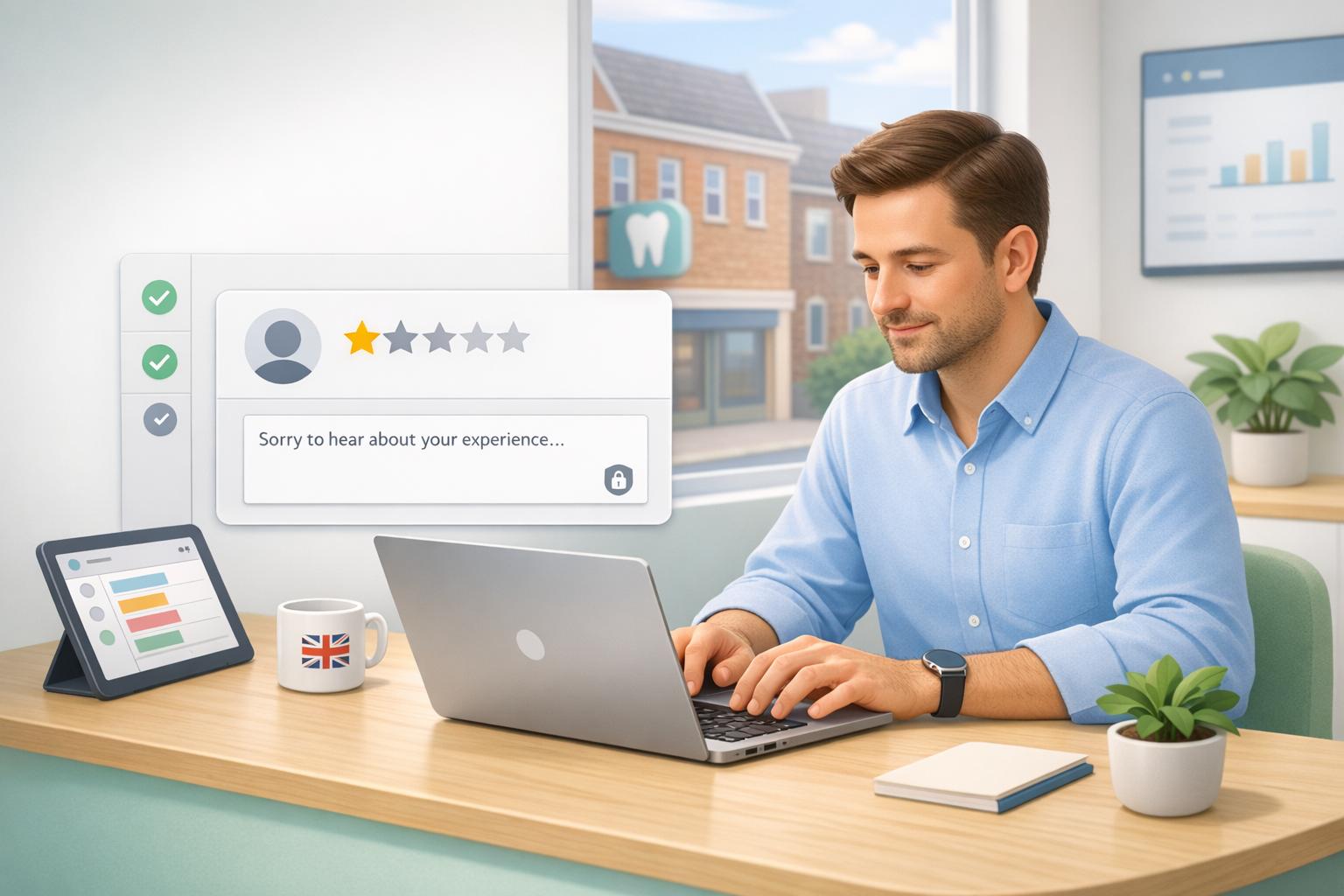
Getting a negative Google review can feel frustrating, especially when you strive to provide excellent care. However, how you respond matters just as much as the review itself. Here’s what you need to know:
- Why Responding is Important: 89% of people read how businesses reply to reviews, and 70% may change their opinion after seeing a professional response. Ignoring reviews can hurt trust and deter potential patients.
- Key Steps to Take:
Example: In March 2026, Bespoke Smile faced seven fake one-star reviews. By acting quickly and rallying their community, they had the reviews removed within 24 hours, preserving their reputation.
Tools to Help: Platforms like Remedico’s Patient Flow™ can track reviews, automate reminders, and simplify communication, reducing negative feedback over time.
Negative reviews are an opportunity to show professionalism, build trust, and improve your practice.
Why You Should Respond to Negative Reviews
How Negative Reviews Affect Patient Trust and Bookings
A thoughtful response can soften the impact of a negative review. When potential patients search for your practice on Google, they don’t just focus on the criticism - they pay close attention to how you address it. A professional, empathetic reply shows that you prioritise patient care and take feedback seriously.
This matters because people are watching closely. 89% of consumers read responses to reviews, and 45% are more likely to visit a business that actively engages with negative feedback [1]. What’s more, 70% of customers change their opinion about a business after seeing a well-written response [1]. That means your reply has the power to turn sceptical readers into loyal patients.
Elizabeth Rule, a Platinum Product Expert for Google Business Profile, highlights this perfectly:
Responding to Google reviews is a business owner’s secret weapon for building trust with potential customers [4].
Interestingly, a few negative reviews can even make your practice seem more genuine. An unblemished 5-star rating can come across as too good to be true, so handling criticism gracefully adds credibility.
UK Regulatory Requirements
While building trust is crucial, it’s equally important to follow UK regulations when replying to reviews. The General Dental Council (GDC) sets strict standards for how dental professionals should handle patient concerns, including online feedback. Mishandling a review or revealing private details could lead to serious consequences, such as a fitness to practise investigation [5].
Never disclose personal or clinical information in your response. This includes confirming someone’s status as a patient, mentioning specific treatments, or sharing any medical details. Under UK GDPR, the Data Protection Act 2018, and the Data Use and Access Act 2025, health information is classified as “special category personal data”, and sharing it publicly is a serious violation [5].
The American Dental Association offers a similar warning:
Never reference a specific person or incident… always protect the patient’s privacy [3].
Instead, use general language like, “Our practice strives to provide the best service to all patients,” and encourage the reviewer to get in touch privately. This approach not only keeps you compliant but also shows professionalism and care.
What You Gain from Professional Responses
Crafting a professional response isn’t just about compliance - it can also transform an unhappy patient into a loyal supporter. With 53% of people expecting a reply within a week, and 33% wanting one even sooner [4], responding quickly - ideally within 24–48 hours - makes a big difference [1].
Take the conversation offline by offering a direct email address or phone number. This keeps sensitive discussions private, prevents public disputes, and gives you a chance to resolve the issue directly. As Review Market explains:
A good response can turn an unhappy customer into a brand advocate [1].
To manage feedback effectively, tools like RemedicoGPT’s AI-assistant can help you track reviews and follow-ups in one place, ensuring no concern goes unanswered. Combining prompt responses with improved internal processes can reduce the number of negative reviews altogether.
sbb-itb-d8b42ea
How to Respond to Negative Google Reviews
How to Handle a Negative Google Review: Step-by-Step
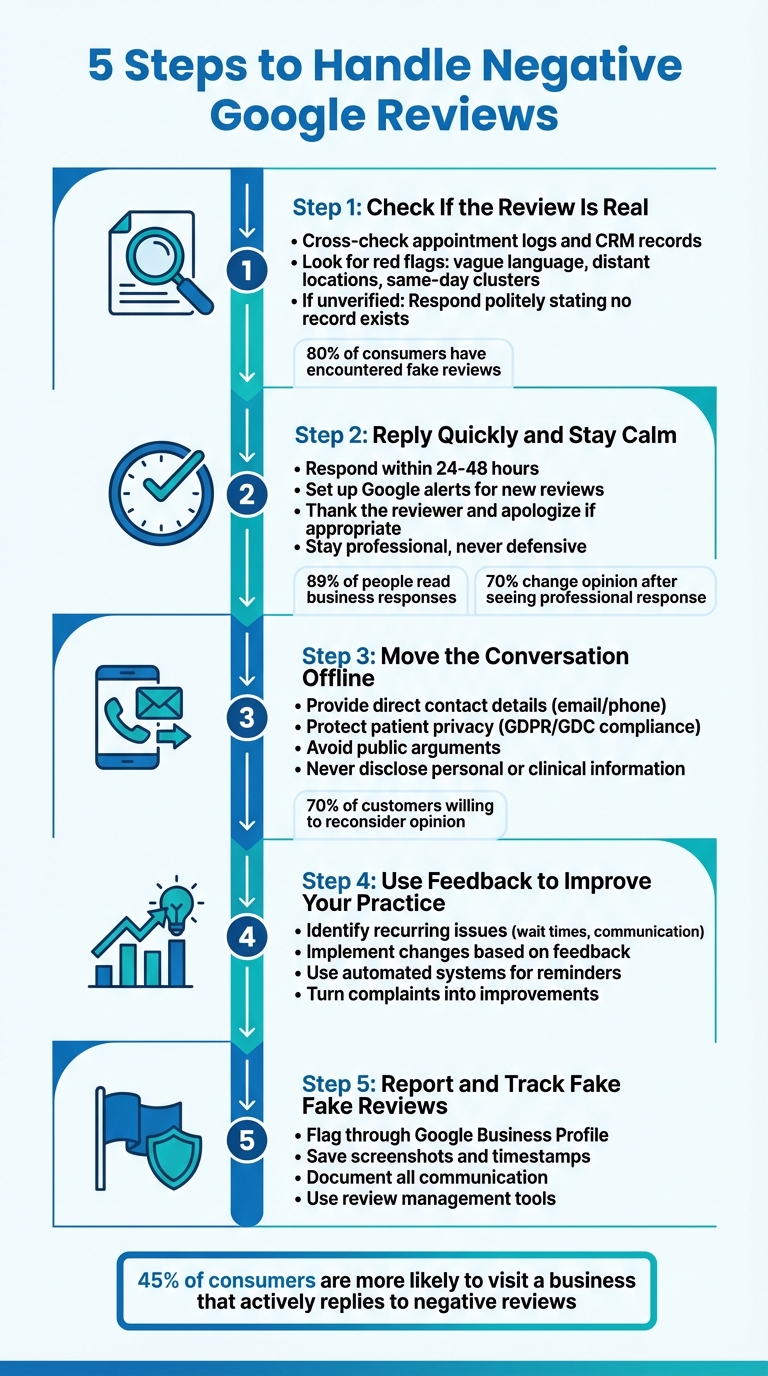
@figure {5-Step Process for Handling Negative Google Reviews in UK Dental Practices} :::
Dealing with a negative review can be tricky, but following these steps can help you manage the situation effectively while maintaining professionalism.
Step 1: Check If the Review Is Real
Before you respond, make sure the review is from a genuine patient. Cross-check details like appointment logs, CRM records, or billing information. If you find no connection to your clinic, the review might be fake.
Fake reviews are more common than you might think - around 80% of consumers have come across them. Watch for warning signs like vague language, reviews from accounts that rate businesses in distant locations, or a sudden influx of one-star reviews on the same day.
Kay Dean, a former federal investigator, highlights this issue:
When you see reviewers reviewing Glo Dental locations reviewing far-flung businesses in common, that’s always a red flag and indicative of a fake review ring.
If you can’t verify the visit, respond politely by stating that no record exists and invite the reviewer to contact you privately. This approach shows transparency while leaving room for clarification from genuine patients. Once you’ve confirmed the review’s authenticity, you can move forward with a response.
Step 2: Reply Quickly and Stay Calm
Timely responses are key - aim to reply within 24 to 48 hours. This shows that you value patient feedback.
Set up Google alerts to get notified the moment a new review is posted. This gives you time to draft a thoughtful response rather than reacting impulsively. Start your reply by acknowledging the review, even if it’s negative. A simple “thank you” can go a long way in easing tension. If there’s been a mistake on your part, offer a heartfelt apology. For instance, one dentist wrote:
I want to express my deepest apologies for your recent experience… I truly wish to understand more about your visit and discuss how we can make things right.
Avoid getting defensive or making excuses. The American Dental Association suggests keeping responses general and patient-focused:
Our office strives to provide the best service to all patients and we do our best to succeed with this goal. I would like to learn more about what happened and hope you will contact us as soon as possible.
Also, never include patient-specific details or clinical information in your reply.
Step 3: Move the Conversation Offline
To protect privacy and avoid a public argument, encourage the reviewer to contact you directly. Provide your contact details in the response. This approach not only keeps the discussion private but also gives you a chance to fully understand the issue and resolve it.
Interestingly, about 70% of customers are willing to reconsider their opinion of a business after receiving a thoughtful response. If the review mentions a specific staff member, consider involving them in the response or signing off with their initials. This adds a personal touch and shows accountability.
Once the conversation is offline, use the feedback to address any underlying issues.
Step 4: Use Feedback to Improve Your Practice
Negative reviews can reveal areas for improvement, such as long wait times or unclear pricing. Use this feedback to make changes within your team.
For example, if patients frequently mention missed appointment reminders, you might implement an automated system like Remedico’s Retention AI™ to send reminders and reduce no-shows.
By acting on feedback, you not only improve patient care but also reduce the chances of future negative reviews. When patients see their concerns have led to changes, they might even update their review or recommend your practice to others.
Step 5: Report and Track Fake Reviews
If you’ve confirmed a review is fake, flag it through your Google Business Profile. Google’s policies prohibit spam, fake content, and competitor-driven reviews. Fraudulent reviews can be removed through their reporting system.
Keep a record of all reviews - both genuine and fake. Save screenshots, note timestamps, and document any communication with the reviewer. This information can be crucial if you need to escalate the issue or demonstrate a pattern of fake activity.
Using tools like Remedico’s Patient Flow™ can help you manage reviews alongside patient interactions, making it easier to cross-check feedback and ensure every review gets a response.
Real Example: Turning a Bad Review into a Good Outcome
Case Study: From 1-Star to 5-Stars
In March 2026, Bespoke Smile - a dental practice based in London and Marlow - faced a sudden crisis when seven fraudulent one-star reviews appeared within just one hour. Clinical lead Lydia Sharples acted immediately to investigate.
It didn’t take long to confirm the reviews were fake. None of the names matched any patient records, and the profile photos were linked to WhatsApp numbers associated with extortion. Instead of engaging with the scammer, Sharples turned to the practice’s Instagram account, rallying their 50,000 followers to report the reviews. The response was overwhelming - approximately 100 people flagged the content, and within 24 hours, Google removed the fraudulent reviews, restoring the practice’s reputation [2].
Sharples later shared:
Google reviews mean so much to us… someone is choosing very carefully if they want to come to you or not [2].
What could have been a damaging incident turned into an opportunity to showcase the loyalty of Bespoke Smile’s patient community. This example highlights the importance of acting quickly and leveraging digital tools to protect an online reputation.
How Remedico Helps with Review Management
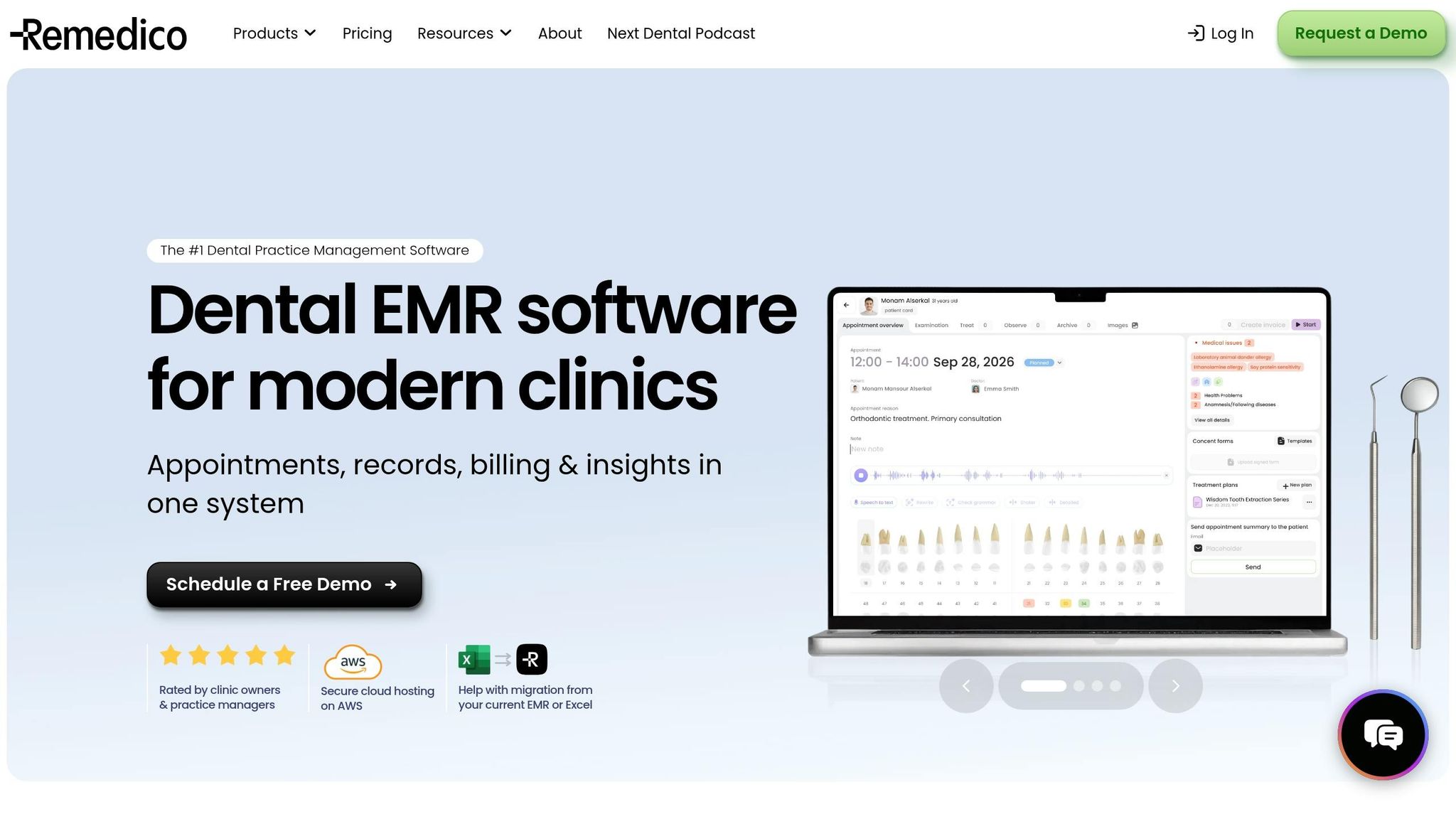
Remedico’s tools, like Patient Flow™ and Smart Calendar, simplify the process of verifying reviews and crafting accurate responses. When a negative review appears, staff can cross-check appointment logs and treatment notes to confirm if the reviewer is a genuine patient. This ensures responses are both quick and fact-based.
Additionally, the platform’s Retention AI™ addresses the underlying causes of negative reviews by sending automated WhatsApp reminders, reducing no-show rates by up to 25% and boosting patient retention by 30% [6]. Fewer missed appointments lead to happier patients and better overall ratings. For situations where issues do arise, the WhatsApp sync feature allows staff to handle concerns privately, often resulting in updated and improved reviews.
This example reinforces the importance of prompt action and shows how the right tools can help maintain and enhance your practice’s reputation effectively.
Key Takeaways
Responding to negative Google reviews promptly - ideally within 24 to 48 hours - sends a clear message that you value patient feedback. Studies show that 89% of consumers read responses to reviews, and 70% reconsider their opinion about a business after seeing a thoughtful reply [1].
When replying, maintain a professional tone, acknowledge the patient’s concerns, and aim to move the discussion offline to protect confidentiality. Before responding, it’s wise to verify the review against your appointment records. If the review appears fraudulent, you can report it to Google as spam or a conflict of interest.
Negative feedback, while tough to hear, can highlight areas for improvement. For instance, if multiple reviews mention long wait times or communication issues, these are areas to address. Responding thoughtfully can make a big difference - 45% of consumers are more likely to visit a business that actively replies to negative reviews [1]. Each response is an opportunity to demonstrate your commitment to patient care.
Beyond reacting to reviews, proactive reputation management is key. Encourage happy patients to leave positive reviews by using automated SMS or email requests. Tools like Remedico’s Patient Flow™ and Retention AI™ are valuable for streamlining appointment reminders and building patient loyalty. Together, these strategies help safeguard and strengthen your practice’s reputation.
FAQs
What should I say in my reply without breaking GDPR or GDC rules?
When replying to a negative Google review, it’s crucial to avoid disclosing any private or confidential patient details. This ensures compliance with GDPR and GDC regulations. Keep your response polite, understanding, and non-specific. For instance, you might say: “We strive to deliver high standards of care and would appreciate the chance to address any concerns directly. Please feel free to contact us so we can discuss this further.” This approach maintains confidentiality while demonstrating a willingness to address the issue. :::
When should I report a Google review as fake, and what proof do I need?
If you suspect a Google review is fake, you should report it, but only if you have solid evidence. For example, the reviewer might not be an actual patient or could be sharing false details. Google makes it simple to flag such reviews directly from your business profile. To make your report stronger, include supporting evidence - this could be patient records or proof highlighting inconsistencies in the review. :::
How can I stop negative reviews happening again in my dental practice?
To keep negative reviews at bay in your dental practice, focus on open communication and maintaining top-notch care standards. Regularly connect with your patients, set clear expectations about procedures, and tackle any concerns quickly to reduce dissatisfaction. Simple steps like improving appointment scheduling can help avoid missed visits - a frequent source of frustration. Additionally, ensure your team is trained to handle concerns with empathy, as this can strengthen trust and stop minor issues from turning into negative feedback. :::